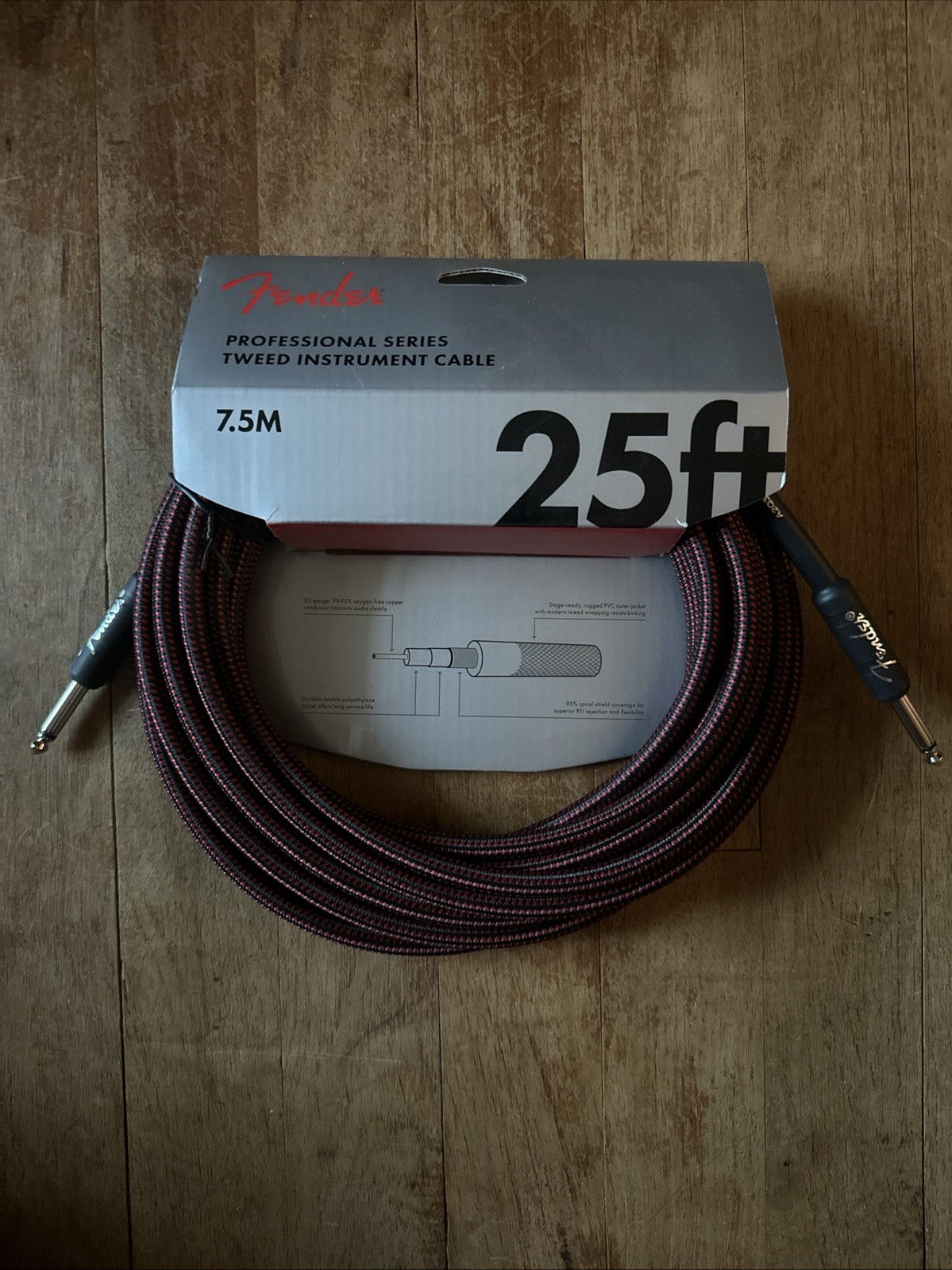

Photos from current listings. Actual item, color, and included accessories may vary.
Fender Professional Series Tweed Instrument Cable Buying Guide
The Fender Professional Series Tweed Instrument Cable combines a classic woven tweed jacket with oxygen-free copper conductors and robust metal connectors, targeting guitarists who want vintage looks plus reliable signal transfer. The core trade-off is between the supple, tangle-resistant tweed outer layer and the thicker, stiffer rubber or PVC jackets found on budget cables; tweed adds abrasion resistance and stage presence but can fray if snagged on rough surfaces. Decision rule: choose the Professional Series Tweed when you need a stage-ready cable with genuine Fender build quality and a 25 ft run; skip it for tight pedalboards where a shorter, low-capacitance cable matters more than aesthetics.


At a glance
- Brand
- Not synced yet
- Model
- Not synced yet
- MPN
- Not synced yet
- Category
- Instrument Accessories
- Status
- Offers available
- Data updated
- Nov 16, 2026
Current offers
Highlights
- Oxygen-free copper (OFC) core with spiral shielding rejects RF interference and preserves high-frequency detail on long runs.
- 25 ft (7.5 m) length adds roughly 0.5–1.5 nF of capacitance versus a 10 ft cable, subtly rolling off treble with high-impedance pickups.
- Woven tweed jacket resists abrasion and tangling better than PVC, but can fray at cut ends if the heat-shrink strain relief is damaged.
- Nickel-plated 1/4-inch TS connectors with molded strain relief handle repeated plug/unplug cycles without intermittent cuts.
Best use cases
- Best fit: stage and rehearsal guitarists running from pedalboard to amp across 20+ feet—pick the 25 ft tweed for durability and vintage look; skip the 10 ft version if you need reach.
- Best fit: vintage-style rigs where the tweed jacket matches a Fender amp or retro pedalboard aesthetic; wrong fit for dense pedalboards where a flat, low-profile patch cable is required.
- Best fit: players who coil cables over-arm and need tangle resistance; wrong fit for permanent installs where a bulk 100 ft roll of bulk cable and separate connectors is cheaper per foot.
Buying tips
- Match cable length to your stage plot: 10 ft for pedalboard-to-amp, 18.6 ft for small stages, 25 ft for large stages; every extra 10 ft adds capacitance that dulls highs with passive pickups.
- Confirm the connector type: 1/4-inch TS unbalanced is standard for passive electric guitar; do not buy a TRS or XLR version for a standard mono instrument run.
- Check the jacket construction: genuine woven tweed over a flexible inner insulator outperforms printed tweed-look PVC for abrasion resistance and coiling memory.
- Prefer nickel-plated or gold-plated connectors over bare brass for corrosion resistance; molded strain relief at both ends prevents the conductor from breaking at the plug.
Specs
| Cable Length | 10 ft / 18.6 ft / 25 ft |
|---|---|
| Connector Type | 1/4 in TS unbalanced |
| Conductor Material | Oxygen-free copper (OFC) |
| Jacket Material | Woven tweed over flexible insulator |
Alternatives to compare

Related searches
What to check before buying
- Measure the distance from your pedalboard or guitar to the amp and add 2–3 ft of slack; choose 10 ft, 18.6 ft, or 25 ft accordingly.
- Verify your amp and pedals use standard 1/4-inch mono (TS) jacks; TRS jacks on some acoustic amps require a balanced cable instead.
- Inspect the tweed jacket at the connectors for secure heat-shrink or overmold; loose fabric at the strain relief is the first failure point.
- Confirm you have a cable tie or hook-and-loop strap for coiling; tweed jackets crease permanently if folded tightly without a tie.
FAQ
Data sources: eBay / Amazon listings and product attribute feeds Data updated Nov 16, 2026.
Some links on this page are affiliate links. If you buy after clicking one, we may earn a commission at no extra cost to you. This does not change which products appear here or their order. Affiliate disclosure.