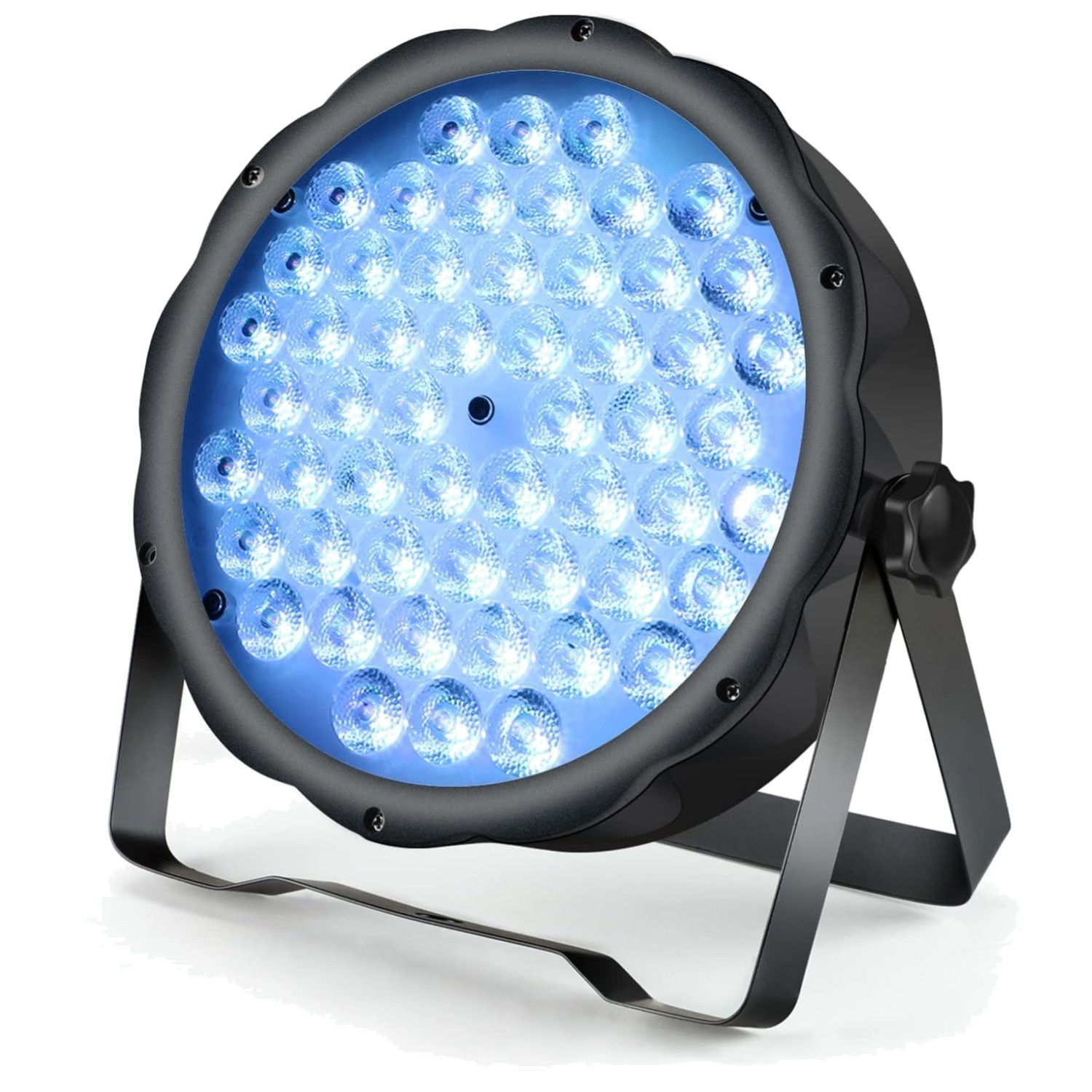

Photos from current listings. Actual item, color, and included accessories may vary.
Professional Stage Light Buying Guide
Professional stage lights are moving-head, par, and wash fixtures built for touring, venues, and worship spaces where output, color consistency, and duty cycle matter. The core trade-off is LED engine quality and thermal design versus upfront cost: budget fixtures dim and shift color as they heat, while pro units hold output and hue across a full show. The decision rule is simple—buy fixtures rated for continuous duty with genuine DMX/RDM control and proper thermal derating, or accept that cheap sound-activated units are party toys, not stage tools.


At a glance
- Category
- Live Sound & Stage Lighting
- Data updated
- Nov 15, 2026
Current offers
Highlights
- LED engine class: professional fixtures use discrete high-CRI diodes (CRI 90+) or COB arrays rated for 50,000-hour L70 life; budget units use low-bin LEDs that dim and shift hue within minutes.
- Control protocol: true pro lights support DMX-512 with RDM feedback plus Art-Net/sACN for networked rigs; consumer units offer only auto/sound modes with 4-8 fixed channels.
- Thermal and duty rating: touring fixtures spec continuous full-output operation with forced-air or heat-pipe cooling; cheap heads require duty-cycle cooldowns and lose 20-30% output when hot.
- Movement and optics: professional moving heads use stepless 540°/270° pan-tilt with 16-bit resolution and glass lenses; budget units use plastic optics and stepper motors that drift and chatter.
Best use cases
- Touring/club install: pick DMX/RDM moving heads and LED pars with locking powerCON and 3/5-pin XLR loop-through; skip sound-activated-only fixtures entirely.
- Houses of worship/rental: choose fixtures with silent convection or low-noise fan modes under 30 dB and RDM addressing to simplify multi-fixture setups.
- Mobile DJ/party: a sound-activated 54-LED par is acceptable for casual use, but do not deploy it as primary stage lighting or in any DMX-cued show.
- Outdoor/architectural: only specify IP65+ rated wash fixtures with sealed connectors—indoor-rated units fail quickly in damp or dusty environments.
Buying tips
- Match fixture count to coverage: a single 100-150W LED moving head covers roughly a 10-15 ft stage pool; plan 2-4 heads for a small stage and 6+ for full band coverage.
- Specify power and data correctly: pro fixtures use Neutrik powerCON TRUE1 or bare-wire terminals and 3-pin or 5-pin DMX; confirm your console and cabling match before ordering.
- Prioritize CRI and color mixing: for front light and camera work require CRI ≥90 and RGBAL or RGBWA+UV mixing; RGB-only units produce poor skin tones.
- Check duty cycle and cooling spec: continuous-duty rating and fan noise (dB at 1 m) determine whether a fixture survives a 4-hour show and stays silent in quiet venues.
Specs
| Control Protocol | DMX-512/RDM, Art-Net, sACN |
|---|---|
| LED Engine | High-CRI COB or discrete diodes, 50k hr |
| Duty Rating | Continuous full-output vs duty-cycle |
| Ingress Rating | IP20 indoor / IP65+ outdoor |
Related searches
What to check before buying
- Measure your stage or truss: confirm fixture weight and clamp compatibility against your truss load rating and mounting hardware before purchase.
- Verify power: total wattage of all fixtures must stay under your circuit breaker (typically 15-20A); plan distro and cable runs accordingly.
- Confirm control chain: ensure your console outputs the fixture's protocol (DMX-512, Art-Net, or sACN) and that you have enough universes for channel count.
- Check environment: for outdoor or damp use require IP65+ rating; for quiet rooms check fan noise spec and consider convection-cooled models.
FAQ
Data sources: eBay / Amazon listings and product attribute feeds Data updated Nov 15, 2026.
Some links on this page are affiliate links. If you buy after clicking one, we may earn a commission at no extra cost to you. This does not change which products appear here or their order. Affiliate disclosure.