Choosing a keyboard piano for music on the move often means deciding between a standalone instrument and a MIDI controller. The Akai Professional MPK Mini Play MK3 aims to bridge that divide: it can play onboard sounds through its own speaker while also serving as a plug-and-play MIDI controller for a DAW.
Quick verdict
Choose the Akai Professional MPK Mini Play MK3 if you want a compact music-making setup that can work away from a power adapter and still connect to computer-based production. Its listed USD 185.39 price buys more than basic MIDI input: battery-powered operation, a built-in speaker, 128+ onboard instruments and drum kits, eight velocity-sensitive MPC pads, four assignable rotary knobs, and an arpeggiator are all part of the appeal.
The main trade-off is focus. If your needs are limited to straightforward MIDI control, the onboard sound library, speaker, and battery-powered capability may be features you do not plan to use. For players who want a portable place to try melodies, beats, and sound ideas before opening a DAW, those same features are central to its purpose.
Who it suits
The MPK Mini Play MK3 makes the most sense for musicians who move between casual playing and computer production. Battery operation rated at 14+ hours supports untethered sessions, while the built-in speaker lets you hear the instrument's onboard piano, synth, pad, and drum-kit sounds without making the speaker an extra piece of gear to bring along.
It is also a logical fit for beat-oriented writing. The eight bankable, velocity-sensitive MPC drum pads give rhythm programming and melodic sample playback a dedicated control surface, rather than placing every idea on the keyboard alone. Four assignable rotary encoders add hands-on control for DAW use.
What stands out from the listed details
The strongest part of the design is the overlap between self-contained play and MIDI functionality. An electronic keyboard with onboard instruments can be used for immediate sound-making, yet the USB-compatible, plug-and-play MIDI setup is positioned for direct connection to a DAW. That combination can make it easier to begin with a quick musical idea and continue refining it in software.
The included sound selection is notably broad in purpose. Acoustic and electric pianos cover familiar keyboard parts, while synth leads and pads point toward electronic arrangements. The arpeggiator further supports pattern-based writing, and the pads provide a separate route for percussion and samples.
Meaningful trade-offs
Portability is a priority here, so consider whether you want an all-in-one creative tool rather than a keyboard dedicated solely to one playing style. The compact, lightweight format and built-in speaker favor convenience, while the pad-and-knob layout places clear emphasis on production control.
The USD 185.39 listed price is most compelling when the battery operation, speaker, onboard instruments, and MIDI tools all matter to your workflow. Buyers who mainly want to connect a controller to a DAW should weigh whether that broader feature set matches their intended use.
Akai Professional MPK Mini Play MK3 - MIDI MK3, Standard
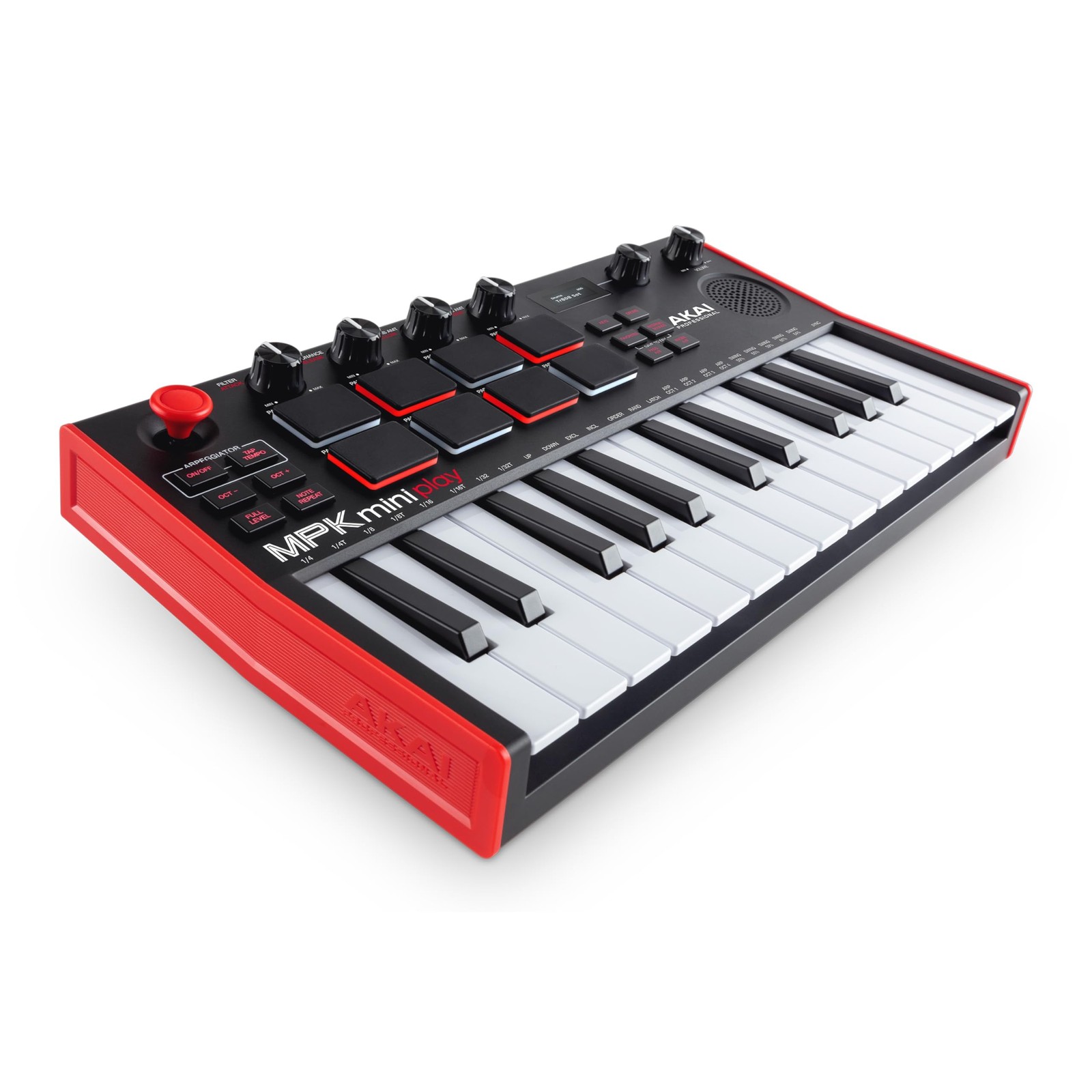
Pick the MPK Mini Play MK3 for portable songwriting, beat creation, and DAW control in a single black keyboard. Its concrete advantage is the ability to combine 14+ hour battery-powered play, onboard instruments, an integrated speaker, and MPC-style pads. Its limitation is equally clear: the controller-oriented extras and self-contained sound features make the most sense for a hybrid workflow, not for someone seeking only minimal MIDI input.
Bottom line
The Akai MPK Mini Play MK3 is built for musicians who want to make sounds immediately, create beats with pads, and transition into DAW work without changing keyboards. At its listed USD 185.39 price, it is best suited to shoppers who will actively use both sides of its design: portable standalone play and USB MIDI control.