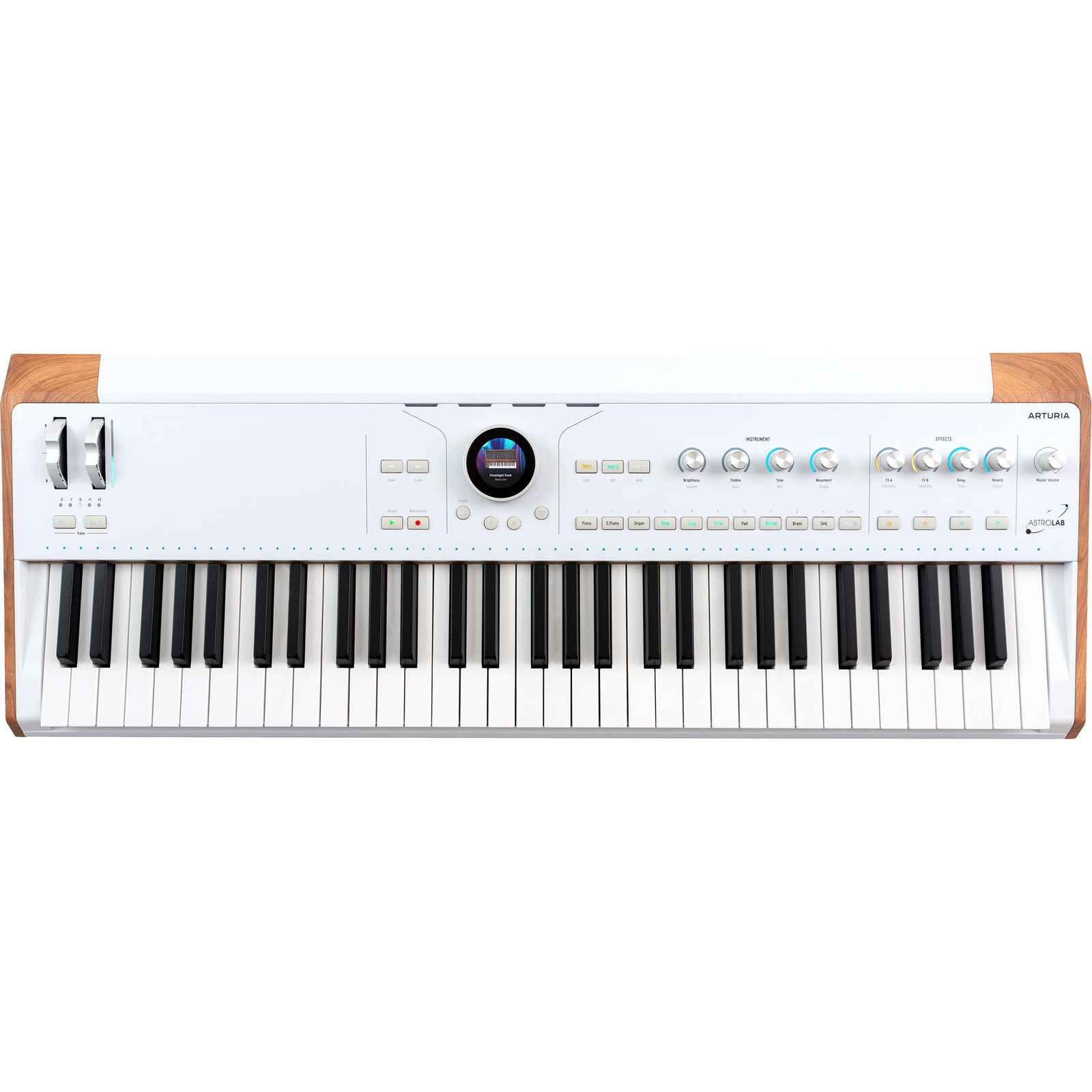

Photos from current listings. Actual item, color, and included accessories may vary.
Arturia AstroLab Stage Keyboard Buying Guide
The Arturia AstroLab is a standalone stage keyboard that runs Arturia's Analog Lab engine natively, blending virtual analog, FM, and sampled instruments into a gig-ready 61-key board. The core trade-off is between its deep software-derived sound library and the tactile immediacy of a hardware workstation—it excels at preset recall and DAW integration but lacks the onboard sequencing and expansion of traditional workstations. Buy it if you want Arturia's plugin sounds without a laptop; skip it if you need splits/layers beyond its fixed architecture or a built-in arpeggiator/sequencer.


At a glance
- Brand
- Not synced yet
- Model
- Not synced yet
- MPN
- Not synced yet
- Category
- Keyboards & Pianos
- Status
- Offers available
- Data updated
- Nov 16, 2026
Current offers
Highlights
- 61-key semi-weighted keybed with aftertouch—synth-action feel suits organ and synth parts but is not a graded-hammer piano substitute.
- Runs Analog Lab V engine standalone with 30+ instruments and 1,300+ presets; expandable via Arturia account but no third-party plugin hosting.
- Dual-layer architecture with split and layer modes, plus 4 assignable knobs and 9 faders for real-time macro control.
- USB-C MIDI/audio interface and 5-pin MIDI I/O; balanced stereo outs and headphone jack for stage or studio routing.
Best use cases
- Best fit: gigging synth-pop or cover-band players who need instant recall of Arturia presets without a laptop—use dual-layer splits for bass/lead or pad/piano.
- Best fit: studio producers who want a hardware controller that also functions as a standalone sound source for sketching—USB-C audio interface simplifies tracking.
- Wrong fit: classical or jazz pianists requiring graded-hammer action and 88 keys—choose a fully weighted stage piano instead.
- Wrong fit: players needing onboard sequencing, arpeggiator, or sampling—AstroLab is preset-focused; a workstation like Fantom or MODX covers those.
Buying tips
- Confirm keybed action: semi-weighted with aftertouch is ideal for synth/organ but too light for advanced piano technique—try before buying if piano is primary.
- Check layer/split limits: AstroLab supports two parts; if you need three or more simultaneous sounds, look at workstations with multi-timbral engines.
- Verify Analog Lab compatibility: AstroLab runs Analog Lab V presets; older Analog Lab 4 presets may need conversion via Arturia Software Center.
- Plan for amplification: AstroLab has no built-in speakers—budget for stage monitor or PA, and use balanced TRS outs for low-noise long cable runs.
Specs
| Keybed Action | 61-key semi-weighted, aftertouch |
|---|---|
| Sound Engine | Analog Lab V standalone, 1,300+ presets |
| Multi-timbral Parts | 2 parts (layer/split) |
| Connectivity | USB-C, 5-pin MIDI, balanced TRS outs |
Alternatives to compare
Related searches
What to check before buying
- Measure your stand or desk: AstroLab is 61 keys (~38 inches wide)—confirm your stand arms or desk depth accommodate its footprint.
- Check power: uses external 12V DC adapter (included); ensure stage power strip has space and correct voltage for your region.
- Verify MIDI/audio routing: USB-C connects to computer for MIDI/audio; for hardware-only gigs, use 5-pin MIDI to connect sound modules or controllers.
- Confirm software account: AstroLab requires Arturia account registration to download additional presets and firmware updates—set up before first gig.
FAQ
Data sources: eBay / Amazon listings and product attribute feeds Data updated Nov 16, 2026.
Some links on this page are affiliate links. If you buy after clicking one, we may earn a commission at no extra cost to you. This does not change which products appear here or their order. Affiliate disclosure.